How to Choose the Right Product to Sell Online (Digital or Physical Guide)
Learn how to choose the right product to sell online in 2026. This step-by-step guide helps you find profitable product ideas based on your skills, market demand, and simple validation methods.
Miss Manifest it All
6 min read
Learning how to choose the right product to sell online is the first—and often hardest—step for new entrepreneurs. With endless options (digital products, physical goods, services, memberships), it's easy to feel paralyzed by choice or waste months building something nobody wants.
The truth? The best product to sell online isn't the trendiest or most profitable option you see on social media. It's the one that aligns with your skills, solves a real problem, and fits your current capacity. This guide walks you through a simple 3-step framework to choose the right product to sell online, plus validation methods to test your idea before you invest time or money.
By the end, you'll have clarity on what to sell and confidence to move forward.
Most new entrepreneurs overthink what they "should" sell. They scroll social media, chase trends, start three different businesses, and finish none. Sound familiar?
The paralysis comes from:
Too many options (digital products, physical goods, services, subscriptions)
Fear of picking "wrong" (what if nobody buys it?)
Comparison trap (everyone else seems to know exactly what to do)
Lack of validation (you're guessing instead of testing)
Here's the truth: the best product to sell online is the one that meets three criteria:
It solves a real problem people are actively searching for solutions to
It aligns with your strengths or interests so you can create it confidently
It's doable for your current season (time, budget, skill level)
You don't need to reinvent the wheel. You need a clear offer and a way to get it in front of the right people.
Why Choosing the Right Product to Sell Online Feels Overwhelming
The 3-Step Framework to Choose the Right Product to Sell Online
Use this framework to identify, validate, and launch your first product with confidence.
Ask yourself:
What do people ask me for help with?
What topics could I talk about for hours?
What skills have I used in jobs, school, or hobbies?
These can hint at aligned offers, like T-shirts with meaning, digital templates, 1:1 sessions, or even physical products.
Tool to try: Use ChatGPT or Claude.ai to brainstorm product ideas from your skills.
Try this prompt:“Give me 5 online business ideas based on my skills in [insert skill]”
Examples of products based on common skills:
Writing/editing: E-books, blog post templates, copywriting guides
Design/aesthetics: Canva templates, brand kits, social media graphics
Organization: Notion templates, planners, productivity systems
Teaching/coaching: Online courses, 1:1 sessions, group programs
Creating physical goods: T-shirts, prints, handmade items, curated kits
The key is starting with what you already know instead of learning an entirely new skill just to launch a product.
Step 1: Identify Your Skills and Interests (What Can You Create?)
Step 2: Research Market Demand (What Do People Actually Want?)
The best product is one that solves a real problem for a real person.
To find out what your audience actually wants:
Browse TikTok search and see what people are asking
Check Reddit threads in your niche
Scroll through Facebook groups or Quora to see common struggles
Look at what’s trending on Pinterest
How to validate demand before building:
Search volume: Use tools like Google Trends or Ubersuggest to see if people are actively searching for your product idea
Competitor research: If similar products exist and are selling, that's proof of demand (not competition to avoid)
Direct feedback: Ask 10 people in your target audience: "Would you buy [product] for $X to solve [problem]?"
Pre-sell test: Create a simple landing page describing your product and see if people sign up or pay before you build it
Validation saves you from spending weeks creating something nobody wants.
Pro Tip: Once you’ve got an idea or two, go back and take the free Notion self-assessment to test if your product aligns with your strengths and season of life.
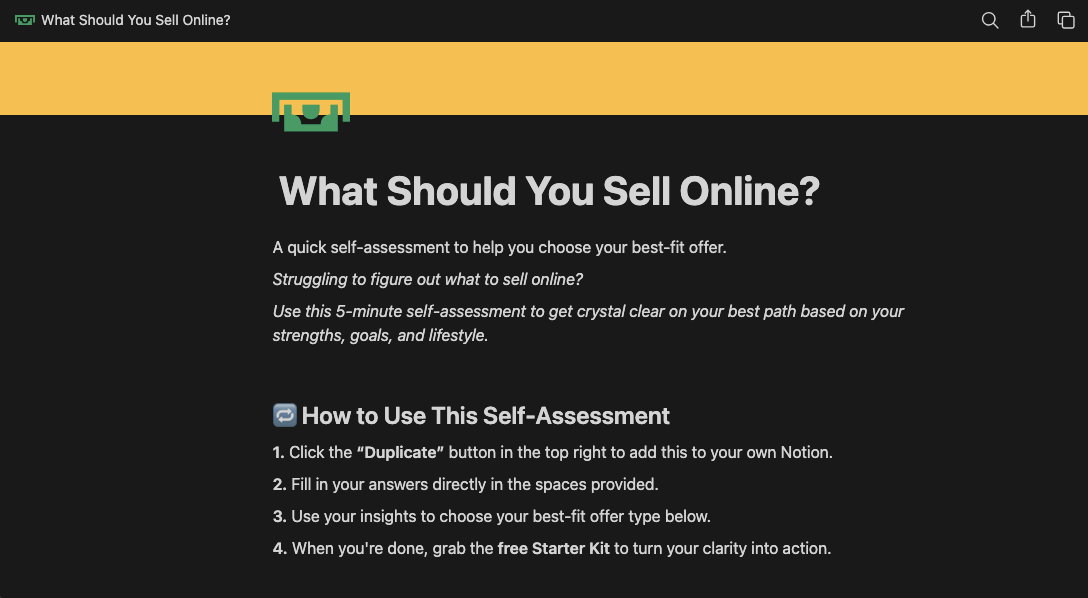
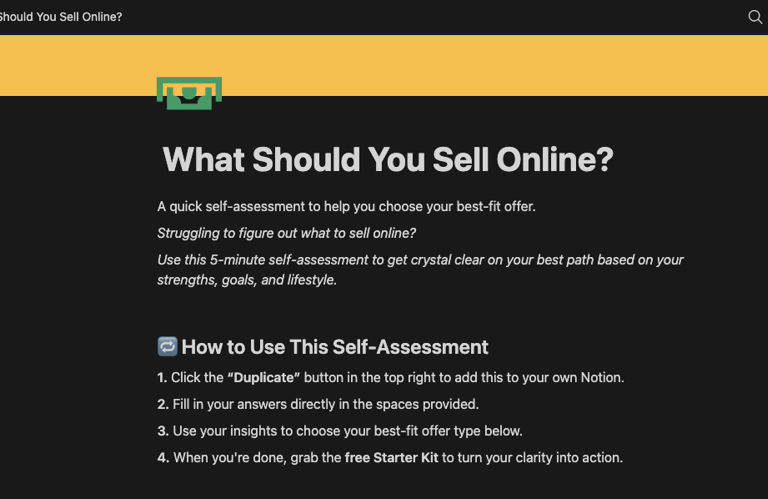
Click here to access the Notion self-assessment.
Step 3: Choose Your Product Type (Digital, Physical, or Service)
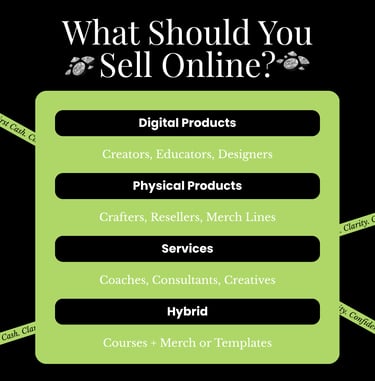
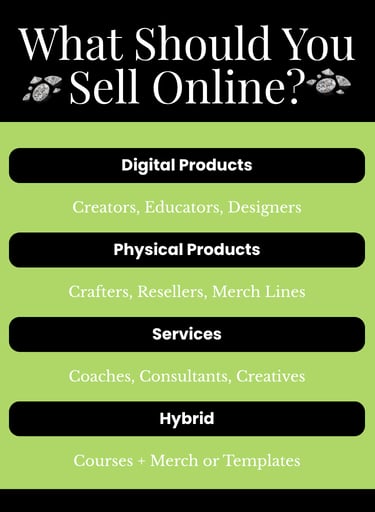
Once you know your skills and your audience's needs, decide which product format makes sense:
Digital Products (create once, sell unlimited times)
Templates, guides, courses, memberships
Pros: No inventory, instant delivery, high profit margins
Cons: Requires upfront creation time, potential for piracy
Best for: Creators with expertise to share, low startup budget
Physical Products (tangible goods shipped to customers)
T-shirts, prints, handmade items, curated kits
Pros: Tangible, giftable, premium pricing potential
Cons: Inventory costs, shipping logistics, lower margins
Best for: Creators who love design/craft, have budget for inventory
Services (1:1 or group coaching, consulting, done-for-you work)
Coaching, consulting, VA services, design work
Pros: Immediate income, no product creation needed
Cons: Trading time for money, harder to scale
Best for: Experts with proven skills, immediate income needs
Hybrid Models (combining multiple formats)
Membership with templates + coaching calls
Physical product bundles with digital guides
Best for: Established creators ready to diversify income
E-commerce is booming: globally, it's expected to exceed $5.5 trillion in annual sales this year. Almost 1 in 3 gig workers in the U.S. are selling digital products or services online because it's low-investment and scalable.
How to Test Your Product Idea Before Launching
Don't build in isolation. Validate your product idea first:
Method 1: The Landing Page Test Create a simple one-page website describing your product with a "Pre-order" or "Join waitlist" button. If 20+ people sign up, you've validated demand.
Method 2: The Survey Method Send a 5-question survey to your email list or social followers asking: "Would you buy [product] for $X?" Track yes/no responses.
Method 3: The MVP (Minimum Viable Product) Launch a simplified version first. Example: Instead of a 12-module course, create a 3-video mini-course and test interest.
Method 4: The Pre-Sell Method Sell your product before you create it. Offer early-bird pricing, deliver after purchase, and use customer feedback to improve.
Once you've got an idea or two, go back and take the free Notion self-assessment to test if your product aligns with your strengths and season of life.
Avoid these pitfalls that derail new entrepreneurs:
Chasing trends instead of solving problems - Trending products have short lifespans; problem-solving products build long-term businesses
Choosing based on what YOU want to buy - Your ideal customer might have completely different needs and budgets
Copying competitors exactly - Similar products are fine, but you need a unique angle (audience, approach, or positioning)
Overcomplicating your first product - Start simple, validate, then expand. A 100-page workbook can start as a 10-page guide.
Skipping validation - Building for months without testing demand is the #1 reason products fail
Trying to serve everyone - "For anyone who wants success" attracts no one. Niche down to stand out.
Choose strategically, validate early, and adjust based on real feedback—not assumptions.
Common Mistakes When Choosing What to Sell Online
Frequently Asked Questions About Choosing What to Sell Online
How do I know if my product idea will sell?
Test it before building. Use landing pages, surveys, or pre-sales to gauge interest. If 10-20 people say "yes, I'd buy this," you have validation.
Should I sell digital or physical products?
Digital products have lower startup costs and higher profit margins. Physical products feel more tangible and premium. Start with whichever aligns with your skills and budget.
What if someone is already selling my product idea?
That's proof of demand! Competition validates that people want this product. Differentiate through your unique angle, audience, or approach.
How much money do I need to start?
Digital products: $0-100 (just time and free tools). Physical products: $200-1,000+ (depending on inventory). Services: $0 (just your time and expertise).
Can I change my product later?
Absolutely. Your first product is a learning experience. Most successful entrepreneurs pivot multiple times before finding their winning offer.
What if I have multiple skills—which should I choose?
Pick the one with the most market demand OR the one you're most excited about. You can always add more products later.
Recommended Tools
ChatGPT or Claude. ai: To brainstorm and refine your idea
MailerLite: Use my link to start building your list early
Notion: To organize your ideas and product roadmap
Your Next Steps After Choosing Your Product
Now that you know how to choose the right product to sell online, here's what to do next:
Today: Complete the free Notion self-assessment and pick your top 2 product ideas
This Week: Validate your idea using one of the testing methods above
This Month: Create your MVP (minimum viable product) and make your first sale
Ready to turn your product idea into reality? Get the Free Boss Up Blueprint to make your next moves clear. Inside, you'll get:
A complete launch checklist
15 profitable online product ideas
A mini prompt pack to create content
Access to our Starter Sprint + Discord community
© 2025 Miss Manifest It All.
All rights reserved.
A brand owned and operated by ByNamaSasha LLC.
Let’s Connect
Stay in the Know
Be the first to get clarity drops, launch tips, and digital money moves.